

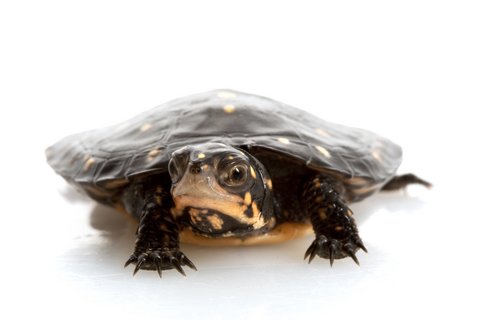
Spotted Turtle for Sale
€199,99
The Spotted Turtle (Clemmys guttata) is a small freshwater turtle known for its smooth, dark shell decorated with bright yellow spots. Native to eastern North America, it inhabits shallow wetlands, marshes and ponds.
Its omnivorous diet includes worms, insects, crustaceans and aquatic vegetation. Before purchasing, ensure you can provide a suitable semi-aquatic habitat and verify the turtle’s legal origin, as the species is protected by wildlife-trade regulations and listed under CITES Appendix II.
Spotted Turtle for Sale | Care & Habitat Guide
The Spotted Turtle (Clemmys guttata) is a small, distinctive freshwater turtle recognised by its smooth, dark shell covered with bright yellow spots. Native to eastern North America, this semi-aquatic species inhabits wetlands, marshes, bogs and shallow freshwater environments.
Its striking appearance and relatively small adult size make it appealing to specialist turtle enthusiasts, but it requires carefully managed habitat conditions and knowledgeable long-term care.
The Spotted Turtle needs access to clean, shallow water, suitable terrestrial areas, hiding places and appropriate basking opportunities. Its omnivorous diet includes worms, insects, crustaceans, molluscs and some aquatic vegetation.
Before purchasing a Spotted Turtle, prospective keepers should understand its husbandry requirements and conservation status. The species is listed under CITES Appendix II, which regulates international trade, and it is protected by additional laws in parts of its natural range. Verify the animal’s legal origin and the permits required for your location before considering a purchase.
Why Is the Spotted Turtle Unique?
The Spotted Turtle stands out for its small size and distinctive yellow-spotted shell. Its dark carapace, often black or bluish-black, is covered with yellow or yellow-orange spots that extend across parts of its head, neck and limbs.
Key characteristics include:
- Distinctive shell pattern: Yellow spots contrast against its dark upper shell, giving each individual a recognisable appearance.
- Small adult size: Adults typically measure around 10–14 cm in shell length, although size varies.
- Semi-aquatic lifestyle: It uses shallow wetlands and freshwater habitats while also spending time on land.
- Omnivorous feeding habits: Its diet includes worms, insects, molluscs, crustaceans and some aquatic vegetation.
- Wetland adaptation: It is associated with marshes, bogs, shallow ponds and other wetlands with suitable vegetation.
- Long-term care commitment: It requires consistent environmental management and appropriate veterinary support.
- Conservation importance: Collection for the pet trade and wetland habitat loss have contributed to population pressures.
Its attractive appearance makes it appealing to specialist turtle enthusiasts, but its conservation needs mean that responsible sourcing should always be a priority.
Spotted Turtle Characteristics
Understanding the species’ basic characteristics helps prospective keepers prepare a suitable habitat.
- Common name: Spotted Turtle
- Scientific name: Clemmys guttata
- Family: Emydidae
- Natural distribution: Eastern North America, including parts of the Great Lakes region and the Atlantic coastal plain
- Natural habitat: Marshes, bogs, wet meadows, shallow ponds and other wetlands
- Shell appearance: Smooth, dark shell with yellow or yellow-orange spots
- Lifestyle: Semi-aquatic
- Diet: Omnivorous
- Adult shell length: Typically around 10–14 cm
- Conservation status: Classified as Endangered in the IUCN assessment commonly cited for this species; national and regional legal classifications vary
- International trade: Listed under CITES Appendix II
These are general characteristics. Individual size, age, sex, health and legal status should be verified with reliable records and the relevant authorities.
Spotted Turtle for Sale: What to Know Before Buying
If you are searching for a Spotted Turtle for Sale, research its care requirements and legal status before making a purchase. This species is best suited to keepers who understand semi-aquatic turtle husbandry and can maintain a suitable wetland-style enclosure.
Before acquiring one, consider:
- Suitable enclosure: Provide an appropriately sized habitat with shallow water and secure terrestrial areas.
- Water quality: Maintain clean water through suitable filtration, testing and regular maintenance.
- Temperature and lighting: Establish appropriate environmental conditions and suitable UVB lighting.
- Shelter: Provide hiding places and vegetation that allow the turtle to feel secure.
- Nutrition: Offer a varied diet appropriate to its age and condition.
- Veterinary care: Identify a veterinarian experienced in freshwater turtles.
- Legal sourcing: Verify the animal’s origin and the documentation required for its sale or transfer.
- Long-term responsibility: Consider the ongoing cost of housing, food, maintenance and veterinary care.
Ask the seller for the turtle’s current shell length, feeding history, health information and source documentation. If it is advertised as captive-bred, request evidence of its breeding origin.
Do not assume that a product listing establishes current stock, captive-bred status, a live-arrival guarantee or delivery availability. These details should be confirmed directly with the seller.
Baby Spotted Turtles
Baby Spotted Turtles require particularly careful husbandry because their small size makes them vulnerable to unsuitable temperatures, poor water quality and inadequate nutrition.
A hatchling enclosure should provide shallow water, safe access to the surface, secure land areas, suitable hiding places and appropriate lighting. The turtle must be able to move between aquatic and terrestrial areas without difficulty.
Before purchasing a hatchling, ask about:
- Its age and shell length.
- Its feeding routine and accepted foods.
- Its health and any known veterinary history.
- Whether it was captive-bred and what documentation supports this claim.
- The legal origin of the animal.
- Any permits or certificates required for the transaction.
Prepare the enclosure before arrival and monitor the turtle’s feeding, movement and general condition. Avoid unnecessary handling while it adjusts to its environment.
Because the species is subject to conservation concerns and international trade controls, check the legal requirements for juvenile animals before purchasing or transporting one.
Adult Spotted Turtles
Adult Spotted Turtles remain relatively small compared with many other freshwater turtle species, but they still need an appropriately designed habitat.
Provide adequate swimming and foraging space, accessible land areas, suitable shelter and stable environmental conditions. Do not assume that a small turtle can thrive in a small, basic aquarium.
Before acquiring an adult, confirm its shell length, feeding history, health information, source documentation and sex, if known. Sex identification should not be treated as guaranteed unless it has been reliably established.
If you intend to house multiple turtles together, consider compatibility, enclosure size, quarantine and potential disease transmission before introducing them.
Captive-Bred Spotted Turtles for Sale
Captive-bred Spotted Turtles may be offered by specialist breeders, but breeding-origin claims should be supported by reliable documentation.
The species has been affected by habitat loss, fragmentation, road mortality and collection for the pet trade. Its relatively low reproductive output and the vulnerability of isolated populations make responsible sourcing especially important.
If a seller advertises a turtle as captive-bred, ask for:
- Verifiable breeding-origin information.
- Available breeding records.
- Documentation establishing legal origin.
- Health and feeding records, where available.
- Details of the turtle’s age and shell length.
- Any applicable permits or certificates.
Captive-bred status does not automatically exempt an animal from wildlife-trade laws. Confirm the requirements applicable to the seller, animal and destination before completing a purchase.
Spotted Turtle Availability and Pricing
Spotted Turtle availability and pricing may vary according to age, size, breeding origin, seller and applicable legal restrictions.
Before comparing prices, verify that the specific animal is available and can lawfully be sold or transferred to your location.
Confirm the following details:
- Current stock status.
- Asking price and additional charges.
- Age and shell length.
- Sex, if reliably determined.
- Captive-bred status and supporting evidence.
- Feeding and health history.
- Required wildlife-trade documentation.
- Transport arrangements and delivery charges.
- Written terms for any guarantee offered.
A higher price does not necessarily establish better health or legal origin. Photographs may also be representative rather than images of the exact animal being offered.
Avoid making unsupported claims about availability, pricing or delivery when publishing a product page.
Spotted Turtle Diet and Feeding
The Spotted Turtle is an omnivore that feeds on both animal and plant matter. Its natural diet includes worms, aquatic insects, molluscs, crustaceans, amphibian eggs and larvae, carrion and some aquatic vegetation.
In captivity, provide a varied and nutritionally balanced diet suited to the turtle’s age, size and condition.
Suitable dietary components may include:
- Commercial turtle food: A nutritionally balanced product formulated for freshwater turtles.
- Earthworms: Suitable worms from a reliable source.
- Insects: Appropriate feeder insects and aquatic insect larvae.
- Molluscs and crustaceans: Suitable food items selected according to specialist guidance.
- Aquatic vegetation: Safe edible plants.
- Other appropriate foods: Additional items recommended by a reptile nutrition specialist.
Important feeding principles include:
- Avoid relying on one food item.
- Provide a varied diet rather than feeding only meat or fish.
- Use safe, reliable feeder sources.
- Remove uneaten food promptly.
- Maintain clean water.
- Discuss calcium and vitamin supplementation with a reptile-experienced veterinarian.
- Monitor appetite and body condition.
Young turtles may have different nutritional requirements from adults. Establish an appropriate feeding routine with guidance from a reliable species-specific care resource.
Spotted Turtle Habitat and Enclosure Requirements
The Spotted Turtle naturally inhabits wetlands with shallow, slow-moving or standing freshwater and abundant vegetation. Its captive environment should provide both aquatic and terrestrial areas, suitable shelter and appropriate basking opportunities.
Indoor enclosure
Indoor housing can make it easier to monitor water quality, temperature and lighting.
A suitable enclosure should include:
- Adequate space for swimming and movement.
- Shallow water with easy access to the surface.
- Stable terrestrial areas.
- Suitable hiding places.
- Appropriate filtration and water maintenance.
- Reliable temperature monitoring.
- Suitable lighting and UVB provision.
- A secure design that prevents escapes.
Plan the enclosure around the turtle’s needs as an adult rather than its current size as a hatchling.
Water quality and depth
Provide clean, appropriately managed water that allows the turtle to move comfortably. The depth should suit the animal’s size and swimming ability, with easy access to land and resting areas.
Filtration, regular water testing and partial water changes help maintain suitable conditions. Remove uneaten food and waste promptly.
Clear water is not necessarily clean water, so use appropriate testing and maintenance routines rather than relying on appearance alone.
Land areas and hiding places
The turtle needs places to leave the water, rest and shelter. Provide stable surfaces, suitable vegetation and secure hiding areas.
Arrange the habitat so that the turtle can move freely between water and land. Avoid steep, slippery ramps and unstable structures that could trap the animal.
Temperature and lighting
Maintain suitable temperatures in both aquatic and terrestrial areas. Use reliable thermometers and consult species-specific husbandry guidance for appropriate targets.
Suitable lighting, including UVB provision for indoor housing, should form part of a complete care plan. Follow equipment instructions and ensure the turtle can access shaded areas.
Avoid sudden temperature changes and excessive heat. Monitor equipment regularly to prevent overheating or burns.
Humidity and ventilation
The enclosure should provide appropriate moisture and shelter without becoming persistently damp or poorly ventilated. Balance humidity with temperature, hygiene and airflow.
Inspect the habitat regularly for mould, waste accumulation and other conditions that could affect the turtle’s health.
Spotted Turtle Temperament and Behaviour
Spotted Turtles use aquatic and terrestrial environments for feeding, movement and resting. Their activity can vary with temperature, season, environmental conditions and individual temperament.
They may retreat into their shells when disturbed. This is a natural defensive response, and excessive handling should be avoided.
Provide a consistent routine, suitable hiding places and enough space to move naturally. Observe normal feeding, swimming and resting patterns.
Persistent loss of appetite, unusual buoyancy, difficulty swimming or other concerning changes should prompt a review of the enclosure and veterinary advice.
How Big Does a Spotted Turtle Get?
Adult Spotted Turtles typically measure around 10–14 cm in shell length, although individual size varies. Females generally grow larger than males. <Cite refs={[“turn827849search5″,”turn827849search6”]}/>
Although small, this species still needs a carefully planned enclosure. Do not use its compact size as a reason to provide inadequate swimming space or poor water quality.
Ask the seller for the animal’s current shell length and any reliable age information before purchasing.
How Long Does a Spotted Turtle Live?
Spotted Turtles can be long-lived animals, so acquiring one represents a substantial commitment. Longevity varies according to genetics, health, nutrition and environmental conditions. Some individuals have been documented living for many decades. <Cite refs={[“turn827849search1″,”turn827849search6”]}/>
Before purchasing, consider whether you can provide appropriate housing, nutrition, maintenance and veterinary care throughout the turtle’s life.
Spotted Turtle Health and General Care
Good husbandry helps support the turtle’s health and wellbeing. Poor water quality, unsuitable temperatures, inadequate nutrition and poor hygiene can contribute to health problems.
Regular care should include:
- Monitoring water quality and temperature.
- Maintaining filtration.
- Removing uneaten food and waste.
- Providing a varied, suitable diet.
- Checking the shell, skin, eyes and limbs.
- Observing normal swimming and feeding behaviour.
- Maintaining appropriate lighting and shelter.
- Identifying a veterinarian experienced in freshwater turtles.
Seek veterinary advice if the turtle develops persistent loss of appetite, shell abnormalities, swelling, unusual discharge, breathing difficulties, difficulty swimming or unexplained weight loss.
Avoid treating suspected infections or shell problems with unverified remedies.
Spotted Turtle Live-Arrival Guarantee
When purchasing a live turtle online, review the seller’s transport arrangements and written guarantee policy before placing an order.
A live-arrival guarantee should only be advertised when the seller explicitly offers it for the animal being purchased and provides applicable terms.
Before ordering, confirm:
- Whether a live-arrival guarantee is offered.
- The conditions required for coverage.
- The deadline for reporting a qualifying problem.
- What evidence is required.
- Any weather-related or transport exclusions.
- Whether the policy covers arrival only or provides additional coverage.
Do not assume that a guarantee offered by another retailer applies to your seller. Request the actual policy before payment.
Spotted Turtle Shipping and Delivery
Transporting a live turtle requires suitable arrangements to protect its welfare. Shipping options depend on the seller, destination, transport method and applicable wildlife regulations.
Before completing a purchase, confirm:
- Whether the seller can legally supply the turtle to your location.
- Which transport method will be used.
- Expected dispatch and delivery arrangements.
- Any additional charges.
- Potential weather-related delays.
- Which documents must accompany the animal.
- How to receive the turtle and transfer it safely into its prepared enclosure.
International transport may require permits and other documentation. A seller’s willingness to ship an animal does not automatically make the transaction lawful.
Confirm all relevant legal requirements before ordering. Do not assume international delivery is available unless the seller confirms it.
Conservation Status and Responsible Ownership
The Spotted Turtle faces conservation pressures associated with wetland habitat loss, fragmentation, road mortality and collection for the pet trade. The IUCN assessment commonly cited for the species classifies it as Endangered, while national and regional conservation designations vary. <Cite refs={[“turn827849search0″,”turn827849search5″,”turn827849search8”]}/>
The species is listed under CITES Appendix II, meaning international trade is regulated. Additional national or regional laws may restrict possession, collection, sale, transport or importation. <Cite refs={[“turn827849search0″,”turn827849search8”]}/>
Before purchasing a Spotted Turtle:
- Request evidence of its legal origin.
- Ask for breeding records if it is advertised as captive-bred.
- Confirm its species identification.
- Check current CITES and national requirements.
- Verify permits or certificates required for the transaction.
- Avoid animals whose origins cannot be established.
- Never release a captive turtle into the wild.
Responsible sourcing is essential for a species affected by collection pressures and habitat loss.
Is the Spotted Turtle Suitable as a Pet?
The Spotted Turtle may appeal to experienced keepers who can provide a carefully managed semi-aquatic habitat. However, it is not a low-maintenance pet, and its conservation status makes responsible sourcing especially important.
Before deciding whether to keep one, consider:
- Can you provide an appropriate enclosure with water and land areas?
- Can you maintain good water quality consistently?
- Can you provide suitable lighting, temperatures and shelter?
- Do you understand its dietary requirements?
- Is a reptile-experienced veterinarian accessible?
- Can you meet its ongoing care costs?
- Can you verify its legal origin and required documentation?
Seek specialist advice if you are unfamiliar with semi-aquatic turtle care. Prioritise the animal’s long-term welfare over appearance or availability.
Frequently Asked Questions About Spotted Turtles
What is the scientific name of the Spotted Turtle?
Its scientific name is Clemmys guttata.
Where does the Spotted Turtle come from?
It is native to eastern North America, including parts of the Great Lakes region and the Atlantic coastal plain.
How big does a Spotted Turtle get?
Adults typically reach around 10–14 cm in shell length, although individual size varies.
Is the Spotted Turtle aquatic or terrestrial?
It is semi-aquatic. It uses shallow freshwater and wetland habitats while also spending time on land.
What does a Spotted Turtle eat?
It is an omnivore. Its natural diet includes worms, insects, molluscs, crustaceans and some aquatic vegetation.
Does a Spotted Turtle need a filter?
Suitable filtration is recommended for maintaining water quality. Regular testing, waste removal and water changes are also necessary.
Does a Spotted Turtle need UVB lighting?
Appropriate lighting, including suitable UVB provision for indoor housing, should form part of a complete husbandry plan. Follow species-specific guidance.
Is the Spotted Turtle endangered?
The species is classified as Endangered in the IUCN assessment commonly cited for it. Legal status varies by country and region, and it faces threats including habitat loss and collection.
Is the Spotted Turtle listed under CITES?
Yes. The species is listed under CITES Appendix II, which regulates international trade. Check the current documentation requirements before purchasing or transporting one.
How can I verify whether a Spotted Turtle is captive-bred?
Ask the seller for verifiable breeding-origin information and supporting records. Confirm the animal’s legal source and any required permits or certificates.
Can a Spotted Turtle be shipped internationally?
That depends on the seller, destination, transport arrangements and applicable legal requirements. Verify delivery availability and documentation before placing an order.
What should I prepare before acquiring a Spotted Turtle?
Prepare a secure enclosure with shallow water, suitable land areas, hiding places, filtration, appropriate lighting and temperature monitoring. Establish a suitable diet and identify a reptile-experienced veterinarian.
Spotted Turtle for Sale: Make an Informed Decision
The Spotted Turtle (Clemmys guttata) is a distinctive freshwater turtle recognised for its dark shell and bright yellow spots. Its compact size and unique appearance make it interesting to observe, but it requires appropriate husbandry, long-term care and responsible sourcing.
If you are researching a Spotted Turtle for Sale, take time to understand its habitat requirements, diet, adult size and conservation status before considering a purchase.
Confirm current availability, health information, legal origin and all required wildlife-trade documentation directly with the seller. If the turtle is advertised as captive-bred or supplied with a live-arrival guarantee, request supporting evidence and written terms before proceeding.
Prioritise responsible sourcing, suitable husbandry and the long-term welfare of this distinctive turtle.
| Choose Size | cb Baby |
|---|---|
| Options | No Pref, Male, Female |
Be the first to review “Spotted Turtle for Sale”
Related products
Turtles for Sale
Turtles for Sale
Turtles for Sale
Turtles for Sale
Turtles for Sale
Turtles for Sale
Turtles for Sale
Turtles for Sale
Reviews
There are no reviews yet.